I’ve spent most of my working life managing things that are supposed to never fail: enterprise networks, service desks, a five-year, USD 140 million managed-services contract that had to run without a single SLA penalty. And for the last decade, on the side, I’ve spent my weekends managing something else that’s supposed to never fail: the air supply of a first-time diver, thirty meters under the surface of the Flores Sea.
For a long time I thought of these as two completely separate lives. One wore a badge and sat in escalation calls. The other wore a wetsuit and checked O-rings. It took me years to notice they run on the exact same discipline.
The problem with too many alarms
At BT, running IT infrastructure managed services for XL Axiata, one of the more unglamorous things we built wasn’t a new capability — it was a reduction. Our monitoring tools were generating so much alert noise that the signals that actually mattered were getting buried in the ones that didn’t. A dashboard that pages you fifty times a day teaches your team to stop looking at it closely. So we spent real effort tuning it down — cutting the noise until the actual spikes, the ones that had been sitting there the whole time, were finally visible again. We didn’t get better at reacting to incidents. We got better at seeing them, because we’d stopped drowning the real signal in a hundred false ones.
That’s the part of “catch it early” nobody tells you when you’re starting out: it’s not about paying closer attention. It’s about deliberately turning down everything that isn’t worth attention, so the thing that is doesn’t get lost in it. A five-year run without an SLA penalty had less to do with vigilance than with having already done the work of knowing what actually deserved vigilance.
Shallow water first, then the drop-off
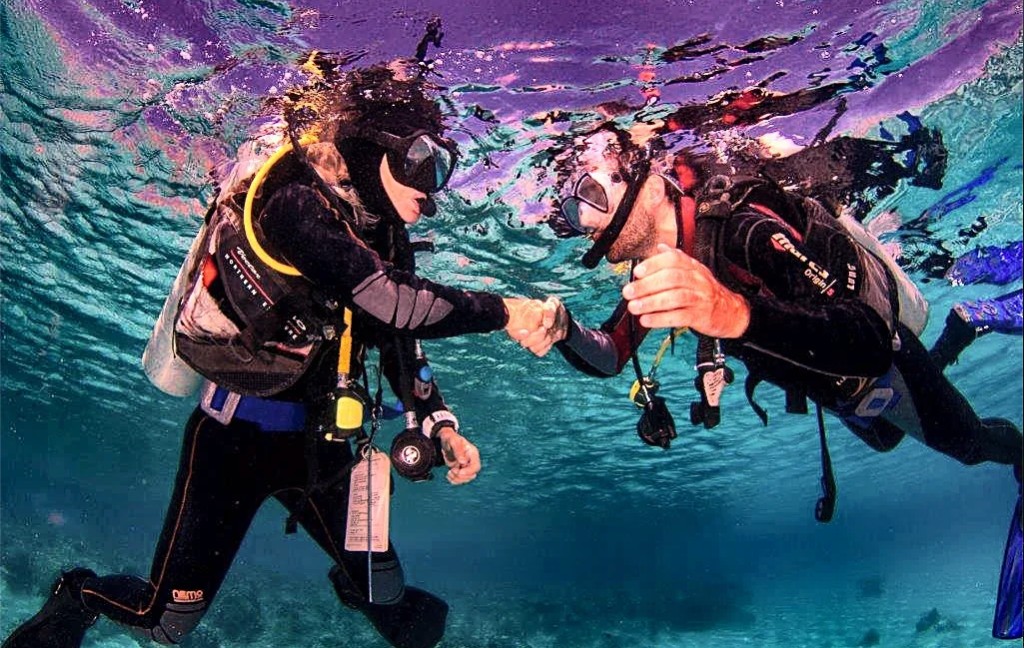
Diving has its own version of that discipline, and it starts before anyone gets near open water. We never take a diver straight to depth. We keep them in the pool, or in shallow water, until buoyancy and breathing are second nature — because the deep part of the dive is the worst possible place to discover that someone isn’t actually comfortable yet. The pool is where you find out what “normal” looks like for this particular diver, so that later, at thirty meters, you can tell the difference between normal and not.
That baseline is what lets you catch trouble early instead of late. Over the years I’ve learned to watch for signs that have nothing to do with technique: a lazy, delayed reaction to a hand signal. Eyes that are a little too wide. A response that doesn’t quite track — someone answering an “OK?” signal with something that isn’t actually an answer. None of these are panic. All of them are what panic looks like five minutes before it arrives, and by the time it’s obvious to everyone, you’ve lost the calm option of just ending the dive early and going back up.
The same signs, on dry land
I didn’t expect that instinct to transfer directly into a corporate escalation room, but it does. A team member who’s quietly become a flight risk, or a project that’s about to blow past its deadline, rarely announces itself with a dramatic failure first. It shows up the same way it does underwater — a lazy response to a question that used to get an immediate answer, a report that no longer quite makes logical sense, someone who’s stopped asking the follow-up questions they used to always ask. The technical dashboards give you the alert-noise problem. The people give you the wide-eyes problem. Both require the same thing: knowing what normal actually looks like closely enough to notice the small deviation, and treating that as the moment to act — not the moment the problem becomes impossible to miss.
Two businesses, one instinct
I run a dive center that’s certified more than a thousand students out of a private pool in Bogor, and I co-own an SSI dive operation in Komodo National Park. I didn’t plan for either to teach the other anything. But tuning a monitoring dashboard and reading a diver’s eyes turned out to be the same skill, wearing different equipment: build a clear enough sense of normal that the deviation is the thing you actually see.
Bogor, September 2026.